
















History of the Historical Society
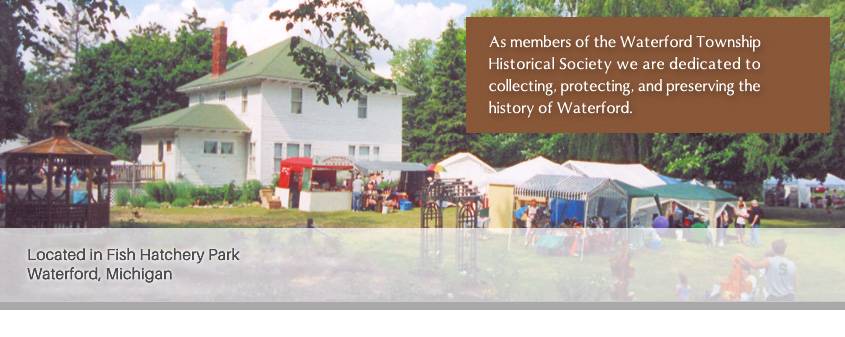
The Waterford Township Historical and Preservation Society, was formed in 1975. The group met in the historic church, built in 1869, on Andersonville Road. They had the church designated as a Historic site on the national level and had the section of Andersonville Road from Dixie to the railroad tracks designated as the Historical District of Waterford. They became inactive from 1980 until Sept. 1990. In 1991, the first active year, new by-laws were written, dues were collected, and an election was held. That same year they moved into the Hatchery House in Fish Hatchery Park. They started with 10 members. As of September 2011, we have over 200 members.
History of Waterford
To understand the history of Waterford, we must go back to when land was being sold to settlers. Michigan was part of the Northwest Territory owned by the British. By the treaty of peace in 1783 between the United States and Great Britain, this area became a part of the United States, but British Troops were not actually evacuated until July 12, 1796. When they left, Captain Moses Porter took possession of Fort Detroit. General Arthur St. Clair was appointed the first governor.
In January 1805, Congress passed an act for the organization of the Territory of Michigan. In 1813, Colonel Lewis Cass was appointed third governor and he formed the boundaries of Oakland County in 1819. Waterford became a township in 1834 and in 1837 Michigan became a state.
After the war of 1812, veterans were being given parcels of land to settle. In 1815, Surveyor-General Edward Tiffin had the area of Michigan outside Detroit surveyed for granting land to the veterans. The report was so discouraging as to the condition of the land and the surrounding area, the veterans were given land in Illinois and Ohio instead. This report was one of the main reasons for the delay in settlement of Michigan.
During the time Michigan was part of the Northwest Territory, there were two main Indian Nations: the Algonquin (who were tribes of the Huron, Ottawa, Ojibwas, Pottawatomie, Miami, Sauk, Sashabaw and others), and the Iroquois. The Algonquin, farmers and trappers, helped the new settlers as they moved westward. The Iroquois were warlike and were finally defeated to just a few by the Algonquin�s who had the help of the soldiers. By the time the settlers ventured into Waterford Village, there were few Indians living in the area.
By the end of 1818, a land office was set up in Detroit and parcels of land were sold.
In the later part of 1818 Major and Mrs. Oliver Williams, Mr. And Mrs. Alpheus Williams, both formerly of Massachusetts; Calvin Baker, Jacob Eilett, and Colonel Beaufait made a journey to Oakland County on horseback.
The party returned after three or four days with specimens of flowers, trees, and shrubs. Oliver Williams and Alpheus Williams, his brother-in-law, entered the first land purchase for $2.00 an acre. Archibald Phillips and Alpheus Williams purchased 161.40 acres in what became the Village of Waterford.
In 1819, Mr. And Mrs. Alpheus Williams, their four daughters and two sons, Captain Archibald Phillips and Major and Mrs. Oliver Williams with their eight children set out to settle Oakland County. The Oliver Williams family established the first farm settlement in the county on the banks of Silver Lake. Archibald Phillips and Alpheus Williams continued on to where the Clinton River crossed the Saginaw Trail (Dixie Highway). This would become the Village of Waterford. Here the first house of the Village was built by Alpheus Williams on the north bank of the river. Archibald Phillips built his home where Andersonville Road meets Dixie Highway. Williams and Phillips also built the first dam where the Clinton River crossed over the Saginaw Trail and erected the first saw mill.
In 1831, Alexis de Tocqueville from France made a trip into the interior of the Territory and came back with a description of beautiful land, abundant game, excellent fishing, pristine lakes, and virgin forests.
Dr. George Williams (no relation to the Williams) was the first physician in the Village of Waterford though he traveled throughout the area. The first resident physician was Dr. Charles Robertson.
The first school classes held in Oakland County were in Oliver Williams' sheep barn in 1821 where seven students attended class. A schoolhouse was later built in 1822. The first school was established in the Village in 1848, on Andersonville Road across from Steffen Street (now a driveway). It was also used by the Methodist for church services. In 1871-72 a two story brick building was built where the present school of Waterford Village is now located. It burned and was rebuilt in 1901.
The first cemetery was deeded by Archibald Phillips to Governor Cass for burial purposes in 1826. The first burial was Olivere Williams (son of Alpheus Willams) who died at the age of 17 in 1820. Olivere�s sister was the second in 1826. Alpheus Williams died July 9, 1828 at age 62 and his wife, Abigail, died September 5, 1826 at age 58. Both Alpheus and Abigail are buried there. That cemetery is still in existence at the end of Clippert Court. Archibald Phillips died in December 1847. We do not know where he is buried.
The first post office in Waterford Township was established in 1834-35 on the north shore of Elizabeth Lake. The first Village post office was established in 1865 when John Owen ran the General Store (later to become Jacober�s Store).
The first store in the Village was the home of Alpheus Williams where he kept of few shelves of staples. After his death, the land exchanged hands many times. In 1837-38, Merrick and Bruce purchased it and built the first established store next to the original home of Alpheus Williams.
In 1854, Horace Huntoon and John Griffen built a store on the Southwest corner of Andersonville Road and Dixie Highway. We know it as Jacober�s Store. In 1927 Henry Ford purchased the store from August Jacober for $700. The store was set up and currently stands in Greenfield Village.
The church building, erected in 1869, is still standing at 5860 Andersonville Road near Dixie Highway. It was renovated in 1976 and is owned by Waterford Township.
The historic district of Waterford Township includes Dixie Highway, a block north and south of Andersonville Road, then Andersonville Road between Dixie Highway and Airport Road, south on Airport road to the RR tracks. The homes and businesses of the area were researched in 1976 by the early Waterford Historical Society. In 1977, the Waterford Historic District was placed on the National Register of Historic Places.
Walking tour books of this district are available at our Log Cabin Store.